The one thing a portfolio has to be is true. The layout, the case-study prose, and the stack badges are decoration on top of a single claim, that this person made this thing. Built by Alex fails that claim on a page about us. That's how we ended up reviewing a web developer we've never hired.
builtbyalex.digital is a freelance portfolio with three case studies. One of them, at /work/market-correct, says Alex designed and developed mrktcorrect.com in 2026. This is that site, and we've never exchanged a word with anyone named Alex.
What the case study claims
The case study lays out its credit the way most portfolios do, in a tidy block of fields. Here's each one next to what's true.
| Field | The case study says | What's true |
|---|---|---|
| Client | Market Correct | Correct, that's us |
| Year | 2026 | Correct, the repo's first commit is dated February 5, 2026 |
| Role | Design & Development | None. Evan Taylor built it |
| Stack | HTML5 · CSS3 · Vanilla JavaScript, Cloudflare | Correct, and visible in view-source |
| Link | "See it live," pointing at mrktcorrect.com | Correct, it's live |
Four of the five lines are accurate. That's what makes the page convincing. The one line that's wrong is the only line a hiring manager is paying for.
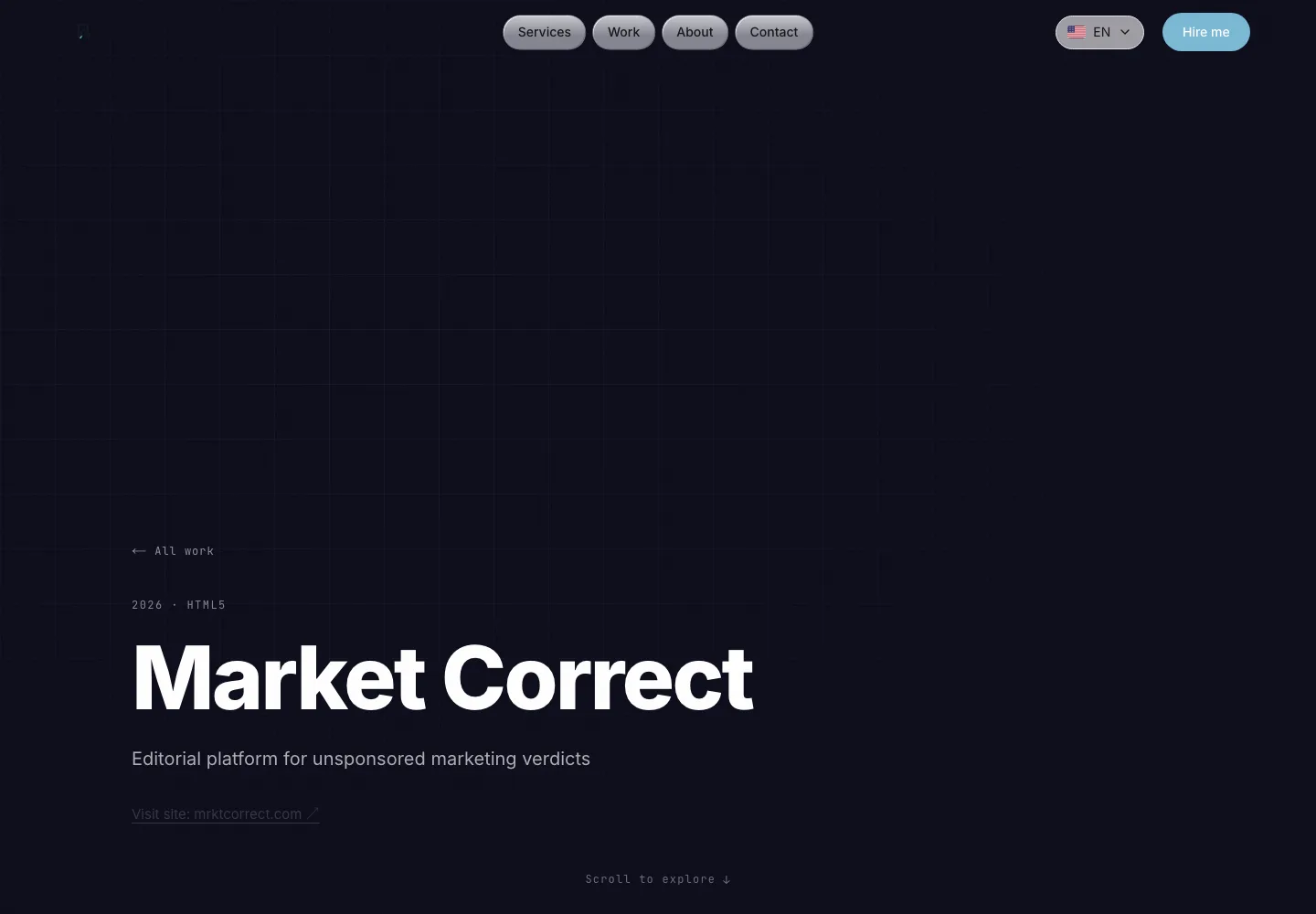 Their case study page
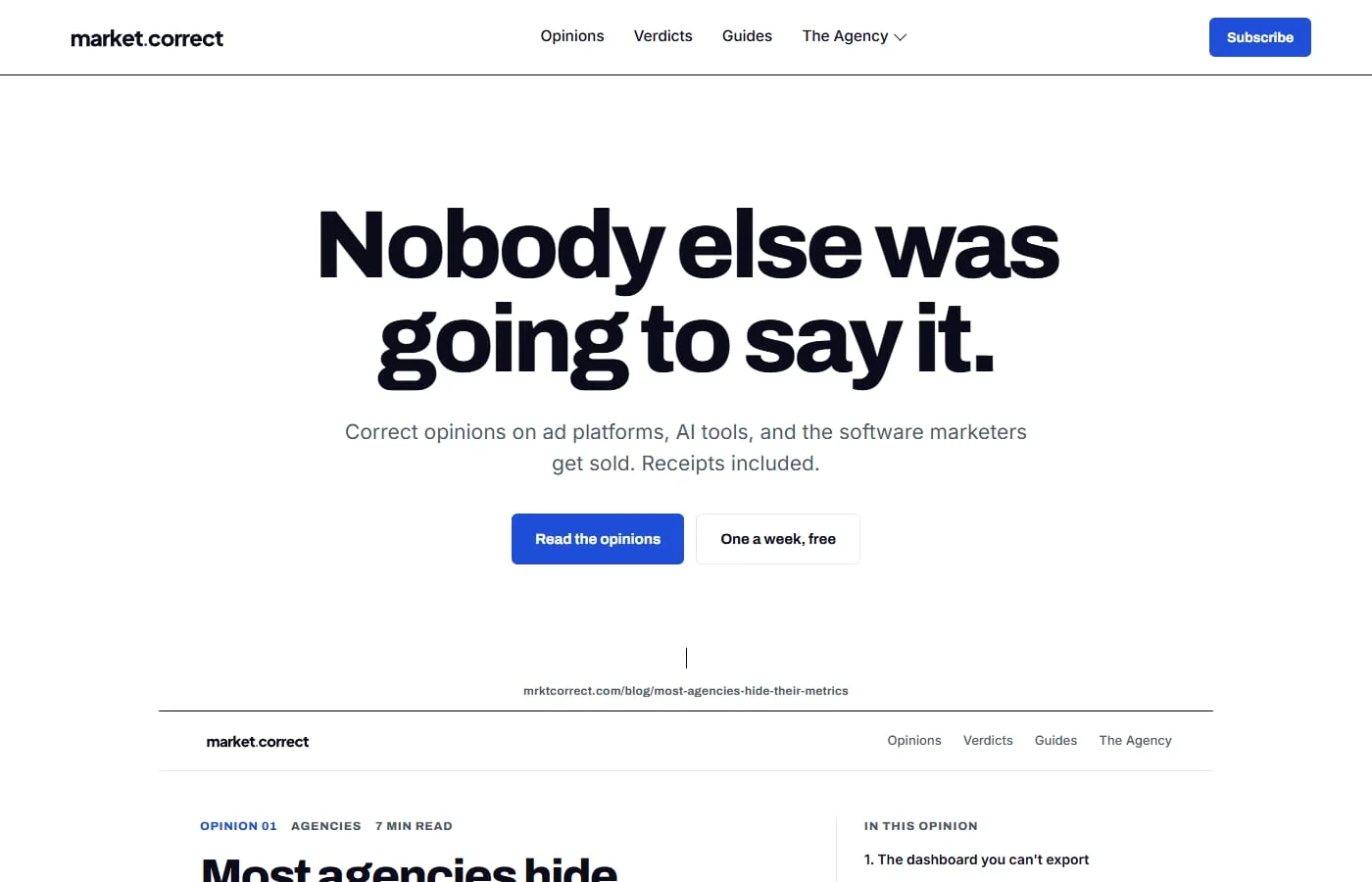 One of its three screenshots, our homepage
Who actually built mrktcorrect.com
Evan Taylor, Market Correct's founder, designed and built the site himself. The repository's first commit is dated February 5, 2026. There was never a contract with anyone named Alex. No invoice, no email, no message in either direction.
So there isn't a role here to argue about, big or small. It's a portfolio entry for a job that didn't happen.
How the case study was written
The case-study copy is detailed, and every detail in it is something you can read on this site. It mentions twelve years running a performance-marketing agency and a 78-post opinions archive. It names the self-hosted fonts (Archivo and Inter), the ink, cobalt, and lime CSS custom properties, the Correct, Partly, and Incorrect stamps on verdicts scored out of 5, and the static HTML on Cloudflare.
All of it is public. The history line and the archive count are on the blog index, the fonts and color variables are in the page source, and the scoring system is on the verdicts page. Reading a building's plaque doesn't make you the architect. The copy was written by someone who read the live site closely, which is a real skill. It's just not the one being advertised.
One more detail. The case study's "Visit site" link uses rel="noreferrer", which strips the referrer when someone clicks through. That's why builtbyalex.digital never once showed up in our traffic reports.
Who Built by Alex says he is
The builtbyalex.digital homepage says "I'm Alex," based in Ukraine, working since 2024, and a Next.js specialist. The services on offer are landing pages, business websites, redesigns, speed optimization, and animation. mrktcorrect.com runs no Next.js at all, which the case study gets right by listing vanilla JavaScript. It's an odd showcase piece for a Next.js specialist, and a very accurate stack list for a site he didn't touch.
The other two portfolio items are POLINO Mosaic Studio and Worldline Corporation. We can't verify either one, and we're not claiming anything about them. We checked the one case study we were in a position to check, and it was us. If you're thinking about hiring from this portfolio, ask each listed client directly.
The verdict, 0 out of 5
Built by Alex gets 0 out of 5. We didn't score the design, the speed work, or the animation, because none of that is what you're buying when you hire from a portfolio. You're buying the person who made the work in it, and the one case study we can check describes work someone else did.
A takedown notice is going to the host. Until the page comes down, treat it as a very thorough review of mrktcorrect.com, written by someone who wasn't there.
How to verify any freelancer's portfolio in five minutes
This is the part that's worth keeping. A false portfolio entry is cheap to publish and cheap to catch, and catching it takes less time than the discovery call. Run these five checks before you sign anything.
- Email the client. Don't use a reference the freelancer hands you. Find the contact address on the client's own site and ask one question, did this person build your site? One email to us would've ended the Market Correct case study in a single reply.
- Check the Wayback Machine. Put the client's URL into the Internet Archive's Wayback Machine and look at the captures around the year the freelancer claims. If the design was already live before the year they say they built it, ask why.
- Check the footer and humans.txt. Plenty of developers credit themselves in the footer or in a humans.txt file at the site root. A missing credit doesn't prove anything, since mrktcorrect.com doesn't carry one either. A credit to somebody else proves a lot.
- Ask for the repo or a staging URL. Whoever built a site has the commit history, a staging link, or at least the hosting dashboard. Ask for a five-minute screen share of any of them. If they won't show you, that's your answer. The person who built mrktcorrect.com can show a first commit dated February 5, 2026.
- Ask what broke during the build. Everyone who has shipped a site has a story about the thing that fought back, a font that wouldn't load or a redirect loop that wouldn't quit. Builders answer that question fast and with specifics. People who've only studied the finished site can't describe anything else.
None of these steps take technical skill, and in our case the first one would've been enough on its own.
If you hire developers for a living, keep the list. If you're one, make the checks easy for your prospects to run. A named client who'll answer an email is worth more than any case study you can write.